Sesimi had grown into an important platform for enterprise brand teams, but its technical foundations and product experience were making it increasingly difficult to support users or move the product forward.
As Senior Product Lead, I led the end-to-end rebuild across product strategy, discovery, delivery and client migration. This was not simply a redesign. We were replacing the core platform while making sure existing customers could continue running their day-to-day marketing operations.
My role
- Defined the product vision and roadmap in line with the company's growth goals
- Led a cross-functional team of 12 across design and engineering
- Facilitated customer research, discovery and delivery planning
- Partnered closely with Customer Success and Brand teams on client migration
- Connected day-to-day product decisions with priorities set by the CEO and leadership team
The challenge
By early 2023, years of technical and user experience debt had made the original platform difficult to change and increasingly fragile.
The front end had grown across React and jQuery environments. Pages were slow, common tasks took too many steps and parts of the product were difficult for engineers to maintain. The template experience also depended on Adobe-based processes, which limited how quickly we could improve it and created avoidable support overhead.
At the same time, the product served more than 60 enterprise clients. Each account used Sesimi differently. Some customers mainly needed an asset library, while others relied on complex templates, compliance tools and approval workflows.
We could not treat the rebuild as a clean-slate product. We needed to improve the platform without disrupting the work customers were already doing.
The question was:
How do we replace the foundations of the product while protecting the experience and trust of existing customers?
The approach
I began by bringing product, design and engineering together around a technical and product audit. We classified existing functionality into three groups:
- Essential to migrate
- Valuable, but safe to defer
- No longer useful and ready to retire
I also segmented customers by how they used the platform. Asset-library users offered a simpler migration path, while template-heavy and compliance-led accounts needed more planning and hands-on support.
This helped us avoid one large, risky release. Instead, we moved through the rebuild in deliberate phases using six-week Shape Up cycles.
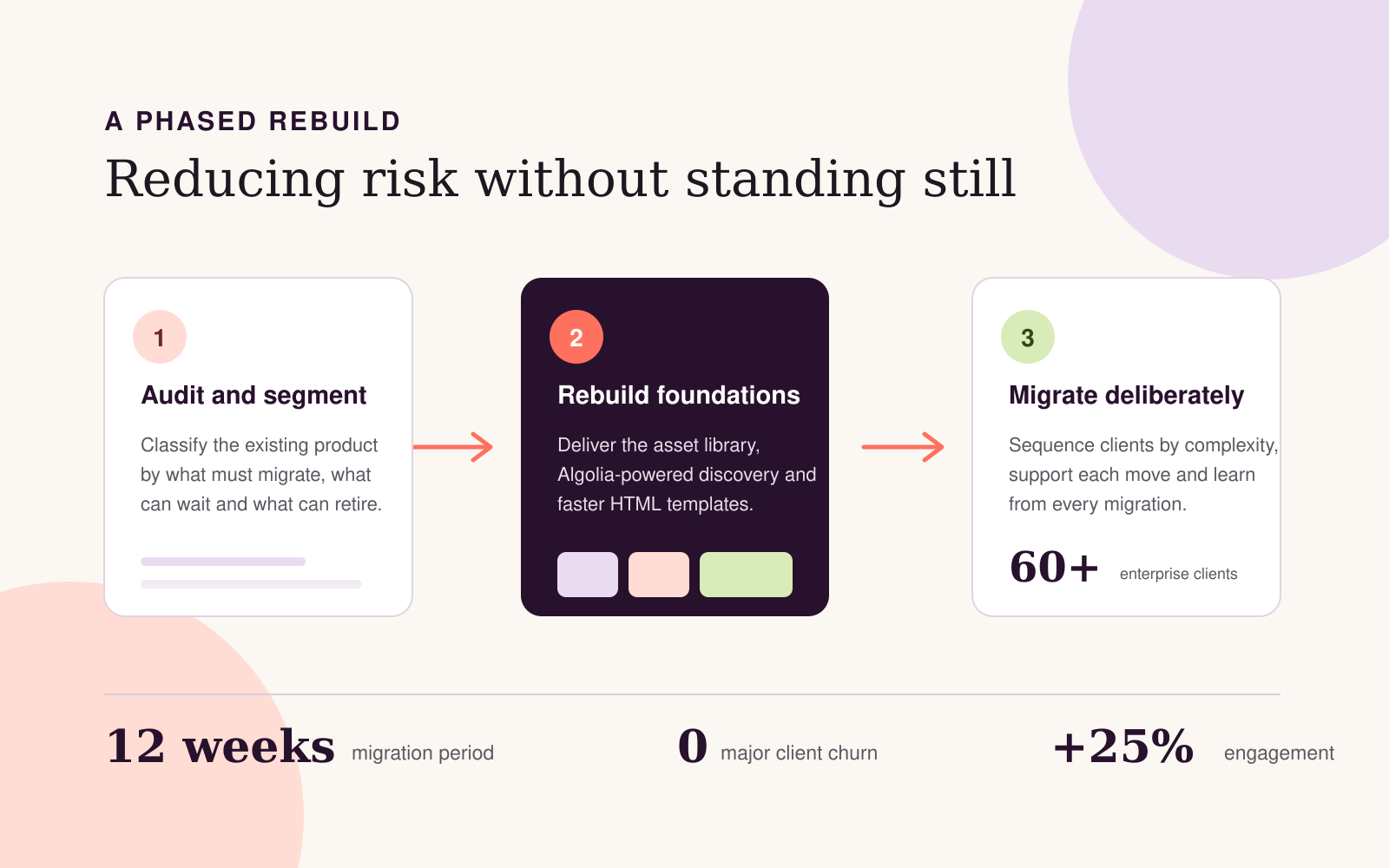
Breaking the work into deliberate phases allowed us to improve the foundations while protecting customer trust.
The first phase focused on rebuilding the asset library. We introduced Algolia-powered search and filtering, and reduced the product's dependence on rigid folder structures. This made assets faster to find and gave the platform a more scalable information architecture.
The second phase focused on the Template Builder. We moved away from the fragile Adobe-based process and introduced HTML outputs, improving speed, reliability and maintainability.
Throughout the rebuild, I ran regular sessions with the CEO and leadership team to make the state of the work visible. I presented progress, risks and trade-offs, and made sure decisions were understood before they became delivery problems.
In parallel, I worked with Customer Success to sequence client migrations, prepare account-specific support and collect feedback as customers moved onto the new platform. The migration itself became part of product discovery. It showed us where the experience was clear and where the product still relied on internal knowledge.
The outcome
The rebuilt platform gave Sesimi a faster, more maintainable foundation and a much clearer experience for enterprise customers.
- Migrated more than 60 enterprise clients over 12 weeks with no major client churn
- Increased product engagement by 25%
- Reduced onboarding time and inbound support queries
- Replaced Adobe-dependent templating with faster, more reliable HTML outputs
- Introduced Algolia search and dynamic filtering to improve asset discovery
- Supported more than 10 new enterprise licences through post-launch product demonstrations
- Gave engineering a stronger foundation for continuous product improvement
What I learned
Leading the rebuild reinforced that platform work is as much about people and trust as it is about technology.
The architecture had to improve, but the project would only succeed if customers understood the change, internal teams could support it and leadership had confidence in the decisions being made.
Breaking the work into phases made the transformation manageable. It allowed us to learn from each migration, improve the next one and keep moving without asking customers to absorb every change at once.
It also reminded me that a rebuild should not aim to reproduce everything that came before it. The real opportunity is to decide what the product still needs, remove what it does not and create better foundations for what comes next.